You Didn’t Lose Sleep. Your Nervous System Locked the “Off-Switch” — and Four Signals Are Jamming It On
Tired all day. Wired at 3am. For thousands of women in perimenopause, sleep never actually broke. The switch that used to power your body down at night got jammed — held shut by a loop of four nervous-system signals that keep each other “on.”

It’s 3am, and you’re awake again. Not anxious. Not turning some problem over in your mind. Just… on — like a lamp someone left burning in an empty room. Your body is wrung out. Your system is lit up. And no amount of exhaustion seems to reach the switch that turns it off.

If that’s your night, you already know the routine by heart. Melatonin. Magnesium. The sleep app. The earlier bedtime, the cooler room, the “wind-down ritual” a wellness account swore by. Maybe your doctor nodded kindly and closed the conversation with the usual four words: “It’s just perimenopause.”
So you filed it away. This is your life now — wired, worn out, and quietly furious at 3am.
But a growing number of somatic and nervous-system educators say that explanation stops one step short. You didn’t forget how to sleep. You didn’t “lose” it. The off-switch that used to power your body down each night got jammed — and it’s being held shut by four things at once.
“You cannot think your way past a switch that’s jammed”
Marianne Ellison has spent two decades teaching women how the nervous system holds — and releases — physical tension. The midlife sleep complaint she hears is almost always the same, she says, and it almost always gets misfiled as a mood problem.
Her point is deceptively simple. Sleep isn’t something you do. It’s something your body permits — but only once it receives the signal that it’s finally safe to stand down. For a body stuck in a low-grade “on” state, that signal never arrives, no matter how tired you are.
To understand why midlife tips so many women into that state, she says, you have to understand three things almost nobody explains.
Perimenopause quietly jammed your body’s chemical “off-switch”
Progesterone does more than regulate your cycle. It’s widely described as one of the body’s most calming hormones — it supports the “brake pedal” side of your nervous system. In perimenopause, progesterone is often the first hormone to fall, and it can fall hard.
Practically, that means the internal brake that used to quiet your system at night is fading — right when you need it most. You didn’t get worse at sleeping. You lost the switch that used to do it for you.
With the brake gone, one “alarm signal” never stops firing
All day, your body braces — at the desk, in traffic, through low-grade stress you barely register anymore. That bracing lives in your jaw, your neck, your shoulders. When your calming brake was strong, your body released it every evening automatically.
Now it doesn’t. The tension stays — and to a nervous system, held muscular tension reads as an alarm: a signal that it isn’t safe to power down yet. So it keeps you in the “alert” gear. Exhausted, but alert. Wired but tired.

The switch has four wires — you can’t flip it by touching one
Here’s the part that reframes everything. That “on” state isn’t one problem — it’s four signals wired in a loop, each one triggering the next. Release any single one and the other three snap it shut again. Ellison calls the loop the “Night Lock.”
This is why the single-fix approach fails so reliably. A pill nudges your brain chemistry. An app tracks your data. A breathing exercise calms your mind for a few minutes. Each one touches, at most, one signal in the loop — while the other three quietly jam the switch shut again.
Score every sleep fix you’ve tried against the jammed switch
None of these are wrong. Many genuinely help you cope, and some may be exactly right for you. But look at where each one is aimed — and notice how few of them ever physically reach the signal holding the switch on.
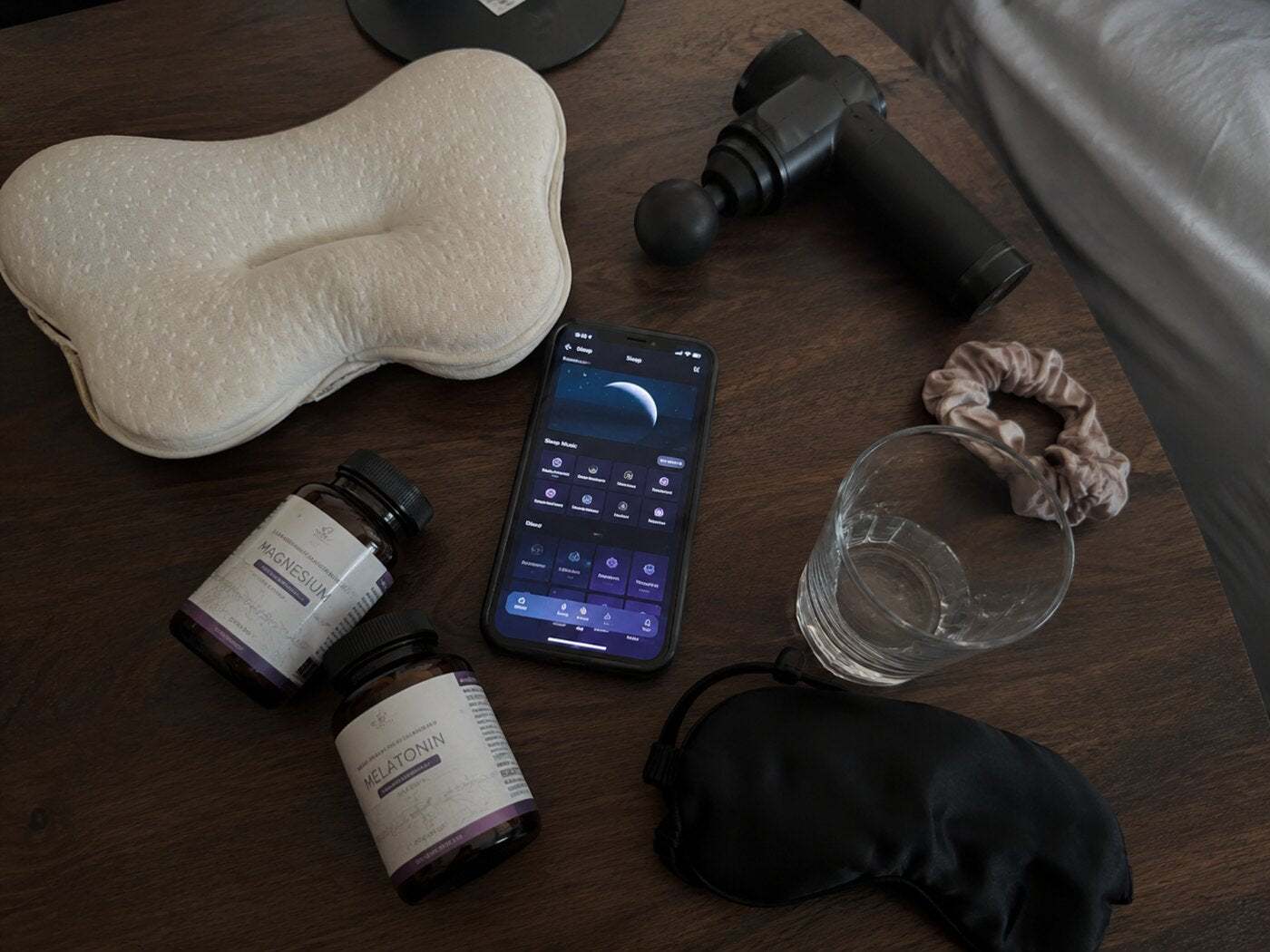
| What you’ve tried | Where it’s aimed | Releases the loop? |
|---|---|---|
| Melatonin | Your brain’s sleep clock | No |
| Magnesium | Brain & muscle chemistry | No |
| Hormone & herbal support | Your hormones | No |
| Sleep apps & trackers | Your data | No |
| Massage gun / pressing in | Pushes down — muscle guards harder | No |
| Meditation / breathwork | Your mind | Partly |
| A physical body-first release | The alarm signal itself | ✓ All four |
Every approach above works top-down — it tries to calm the mind and hopes the body follows. Only one works bottom-up: quiet the body’s alarm, and let the nervous system finally stand down.
The step almost everyone skips: quiet the alarm at its source
Bodyworkers have understood this for a long time. Before your nervous system will downshift into rest, the physical tension sounding the alarm has to come out of the tissue. And here’s the catch nobody mentions: everything that presses down on a braced muscle makes it guard harder. A massage gun, a thumb, a lacrosse ball against the wall — the muscle reads incoming pressure as one more threat and clamps. You make the alarm louder with every push.
Cupping does the opposite. Instead of pressing in, it gently lifts the tissue up and away — and a muscle that’s being lifted can’t brace against the pull. It lets go. The Vela X™ Smart Cupping Massager runs that lift in three parts:
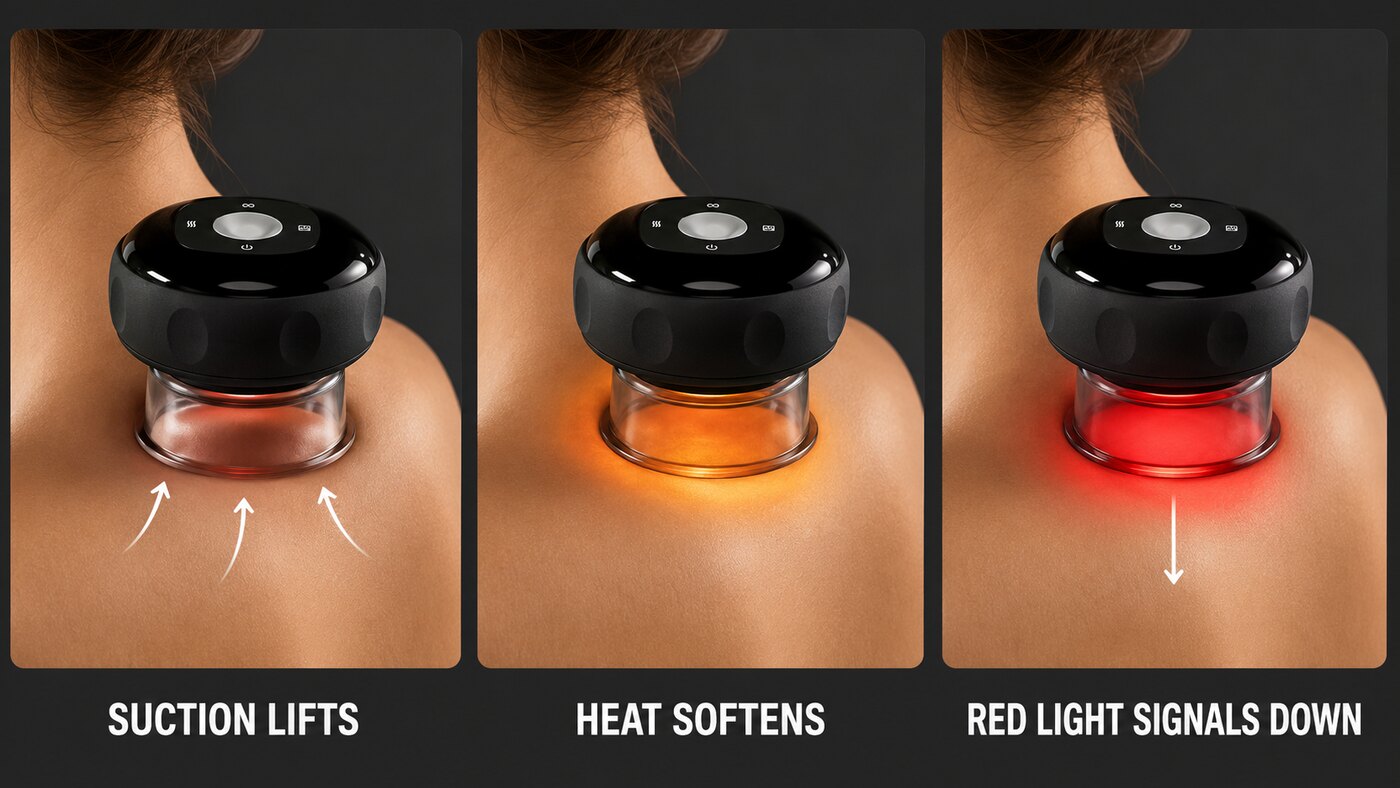
Warm — soften the tissue
Therapeutic-range heat softens the fascia, which stiffens through the cool night hours and holds the tension in place. Nothing releases until it’s warm.
Lift — gentle suction, not pressure
Dynamic Negative Pressure™ pulsing vacuum lifts and decompresses the layer where the alarm is stored — reaching what pressing down never can, feather-light and mark-free on the lowest settings.
Signal down — the body powers off
A ring of 660nm red light completes the sequence. Warmed, lifted, quieted — the alarm falls silent and your nervous system finally receives the “safe” signal, shifting out of alert into rest: The Downshift Response™.
It’s worth saying plainly: this is not another thing to swallow. No melatonin, no magnesium, no prescription. It’s a physical, ten-minute wind-down aimed exactly where the alarm actually is.
The device the ritual is built around: Vela X™
Of the at-home options, the Vela X™ Smart Cupping Massager is the one written up most often for this exact use — because it does all three steps at once, in a single palm-sized pod that’s genuinely easy to use hands-free on your own neck and shoulders in bed.
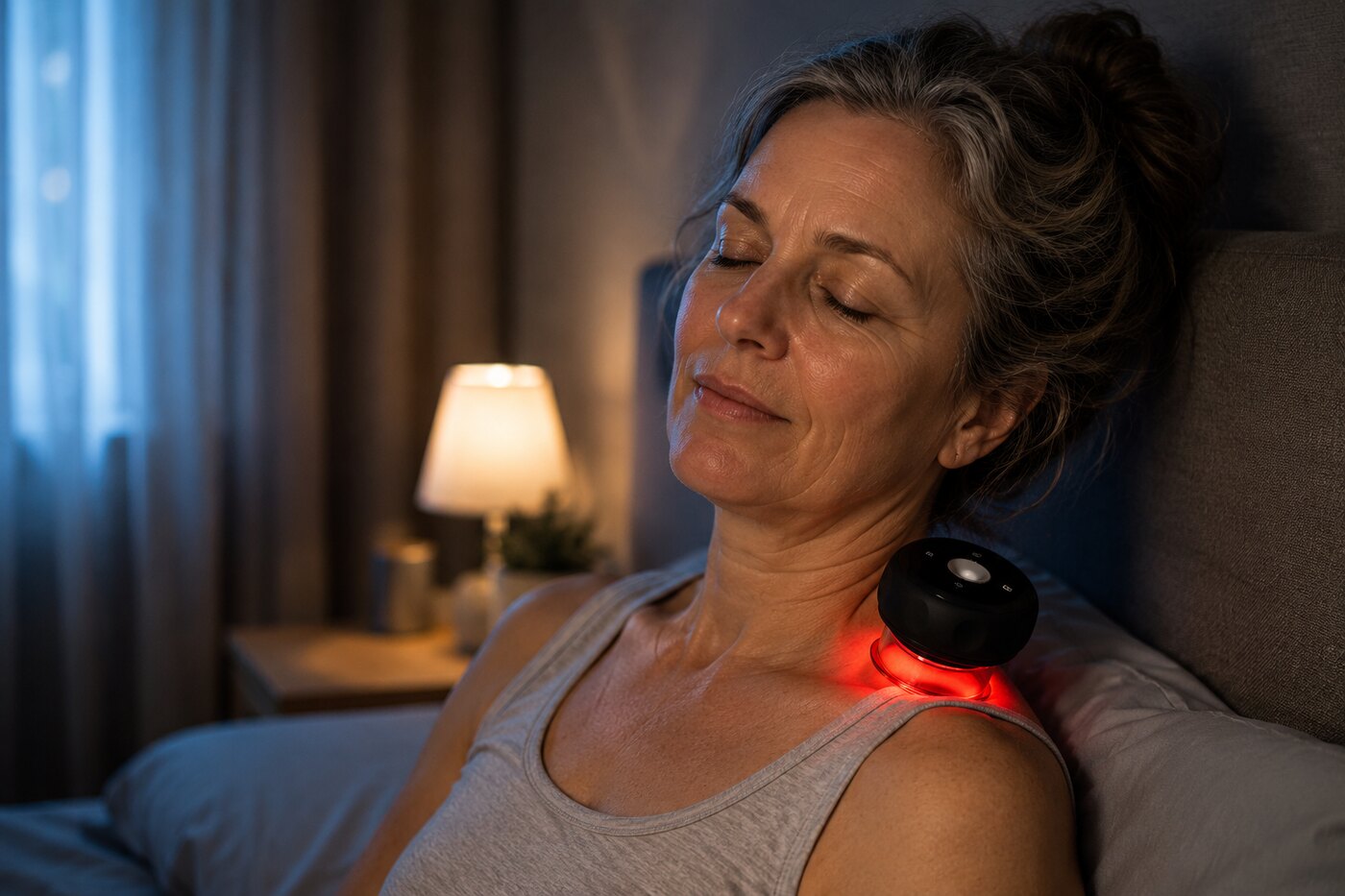

- Hands-free, cordless, rechargeable, palm-sized
- Feather-light & mark-free on the low settings — you control the intensity
- A single 10–15 minute session before bed initiates The Downshift Response™
- Bonus: Vela X Body Map — neck / suboccipital / upper-back placement guide
- Bonus: Nightly Downshift Protocol — 7-day before-bed routine

Try Vela X Risk-Free for 30 Days
Use it for a full month of nights. If The Downshift Response™ doesn’t earn a permanent place in your bedtime routine, return it within 30 days for a full refund — no forms, no return shipping. The risk sits with us, not you.
What women using Vela X™ are reporting
“I have knots ALL the time between my shoulder blades. I started using this at the trapezius, and three nights in, the 3am wake-up didn’t happen. I don’t know how else to explain it. It just didn’t happen.”
“My neck is tight, stiff and hard to turn. I’ve had two massages a month for four years. The Vela X massager does something in 12 minutes that the massages don’t hold for four weeks. My neck actually moved freely the morning after my first session.”
“Too much tension to fall asleep was my life for two years. I thought it was anxiety. I tried the pod at my neck, fifteen minutes before bed. I slept until 6:30 the first night. I cried.”
“Waking up and not being able to fall back asleep was destroying me. My husband said I was a different person. Six weeks of nightly use and I sleep through. I’m back.”

Individual results may vary.
Straight from the comments
We stopped counting the replies under the Vela X posts. A few from women who found the neck-tension connection on their own:

Comments reflect individual experiences and are not guaranteed outcomes.
Your three options
Do nothing. The 3am wake-up continues. The alarm keeps firing. The morning version of yourself stays borrowed against a debt that keeps growing.
Keep trying the fixes aimed at your brain. More melatonin. A new app. Another pillow. You already know how that ends — the brain was never the switch that jammed.
Try the Vela X™ Smart Cupping Massager for 30 days. 10–15 minutes at the neck before sleep. If The Downshift Response™ doesn’t follow, return it for a full refund. The only risk is one month of nights.
The takeaway
If you’ve tried everything and nothing worked, the failure was never your willpower. You were reaching for your brain when the switch was jammed in your body.
You can’t flip a four-wire switch one wire at a time — and you can’t think a coiled body loose. But you can physically release it. Most women say their body finally winds down, and they drift off faster, within the first week or two.