A Nurse's Discovery: Why Feet Feel "Packed" by Hour Twelve — and Why Everything You've Been Pressing Into Them Is Backwards
If you're a nurse — or anyone who spends twelve hours standing on hard floors — and your shoes fit fine at 7am but feel a size smaller by the time you clock out, the problem might not be your feet. It might be the direction of everything you've tried to fix them with.
I've worked twelve-hour shifts on hospital tile for eleven years.
I thought I understood tired feet. I didn't understand the direction I'd been treating them in — and that turned out to be the whole problem.

I only understood why it mattered once I thought back to what my own nights actually looked like.
The 7pm Moment That Doesn't Change
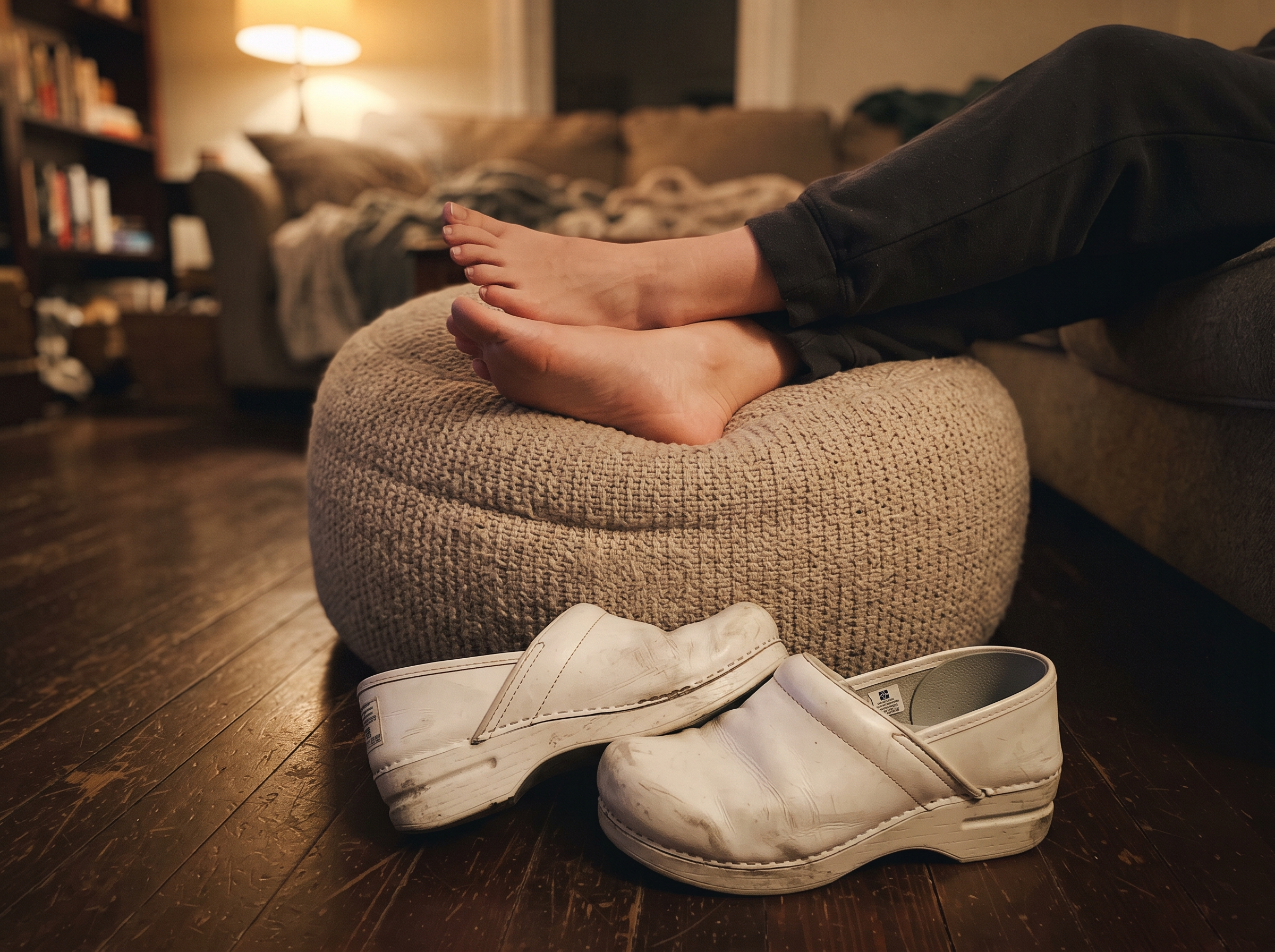
By 7pm, the moment is always the same. I sit on the edge of my bed, unlace my shoes, and peel them off like I'm defusing something.
My feet feel packed. Full. Like they don't quite fit inside themselves anymore.
The sock marks stay for almost an hour. I used to think that was just normal — what happens after twelve hours on concrete.
Turns out I had it backwards. Not about the tiredness. About the direction of everything I'd been doing about it, every single night, for eleven years.
The Drawer Full of Almost-Fixes
Here's what's actually in my hallway closet right now — and every single item shares the same direction problem, even though none of them look alike.
Gel inserts, ordered off a nurse forum because three separate coworkers swore by them. They helped for about the first hour of a shift. By hour eight, packed feet again — because inserts cushion from below. They don't change the direction of anything happening inside the tissue.
Compression socks. Two pairs. I hated putting them on more than I hated the packed feeling itself — hot, a fight to pull up after a shift, and they leave their own marks that just replace the shoe marks. Socks squeeze inward. Still not the direction that mattered.
A frozen water bottle I used to roll under my arch on the kitchen floor. Felt good for maybe five minutes — but for those five minutes it was just pressing up into my arch, compressing it more. The relief left the second I stood back up.
A hard rubber ball, same idea, slightly worse. One night I pressed too hard and it actually felt tighter the next morning, not looser. Pressing in is pressing in, no matter how hard or soft you do it.
A massage gun my sister-in-law lent me. Loud, and honestly a little frightening to point at the bottom of my own foot. Every single hit was still — pushing in.
Every item in that drawer, no matter the brand or the price, was built around one idea: press on it, push harder, compress it until something gives. Not one of them ever asked whether pressing in was even the right direction. And underneath all of it sat a quiet worry — what if pressing on an already-packed foot is exactly how you make it worse?
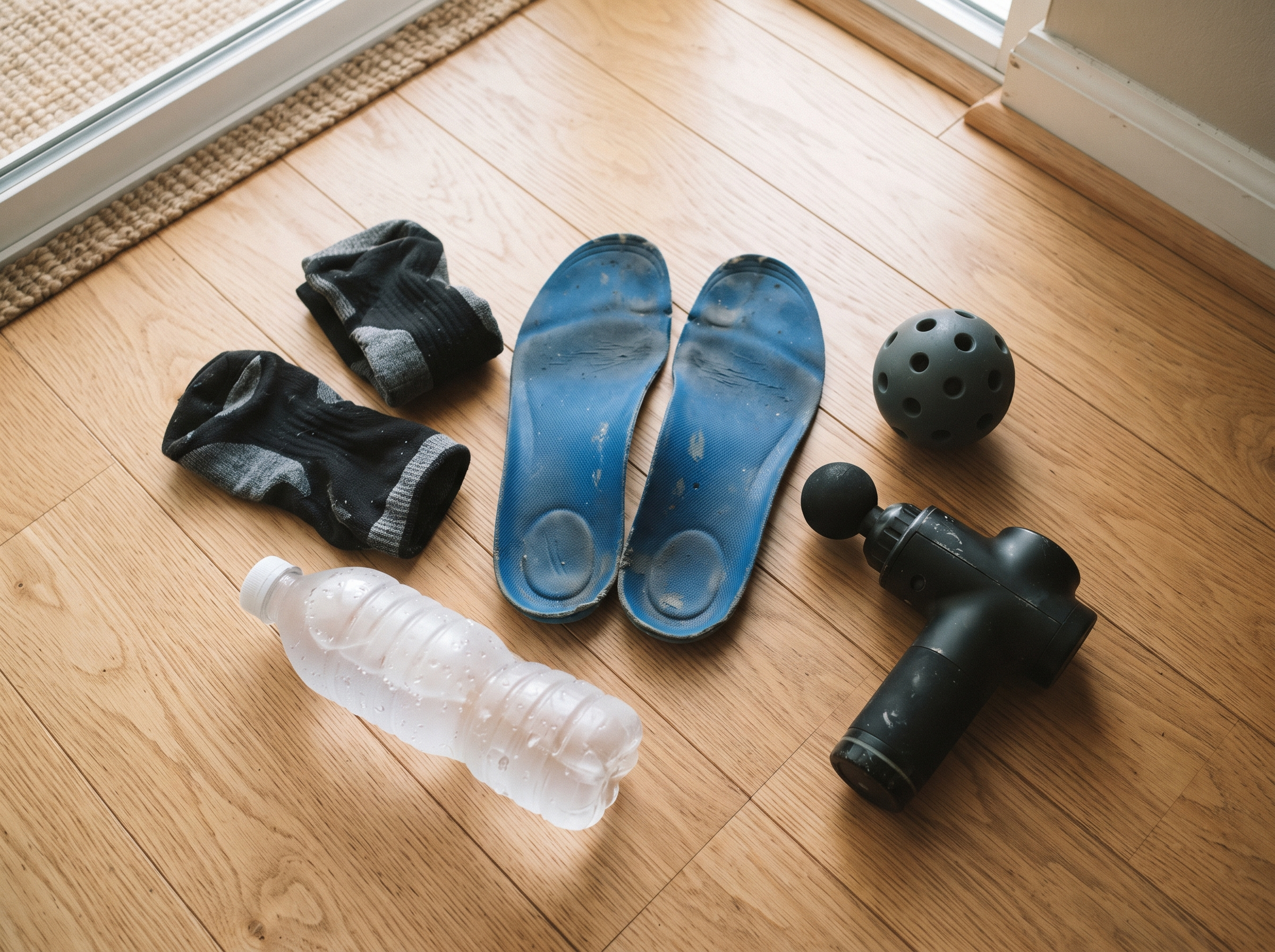
That worry turned out to be the right instinct, just pointed at the wrong culprit. The culprit was never any one product. It was the direction every single one of them shared.
The Most Overlooked Cause of "Packed" Feet
Here's the part nobody explained to me in eleven years on a hospital floor.
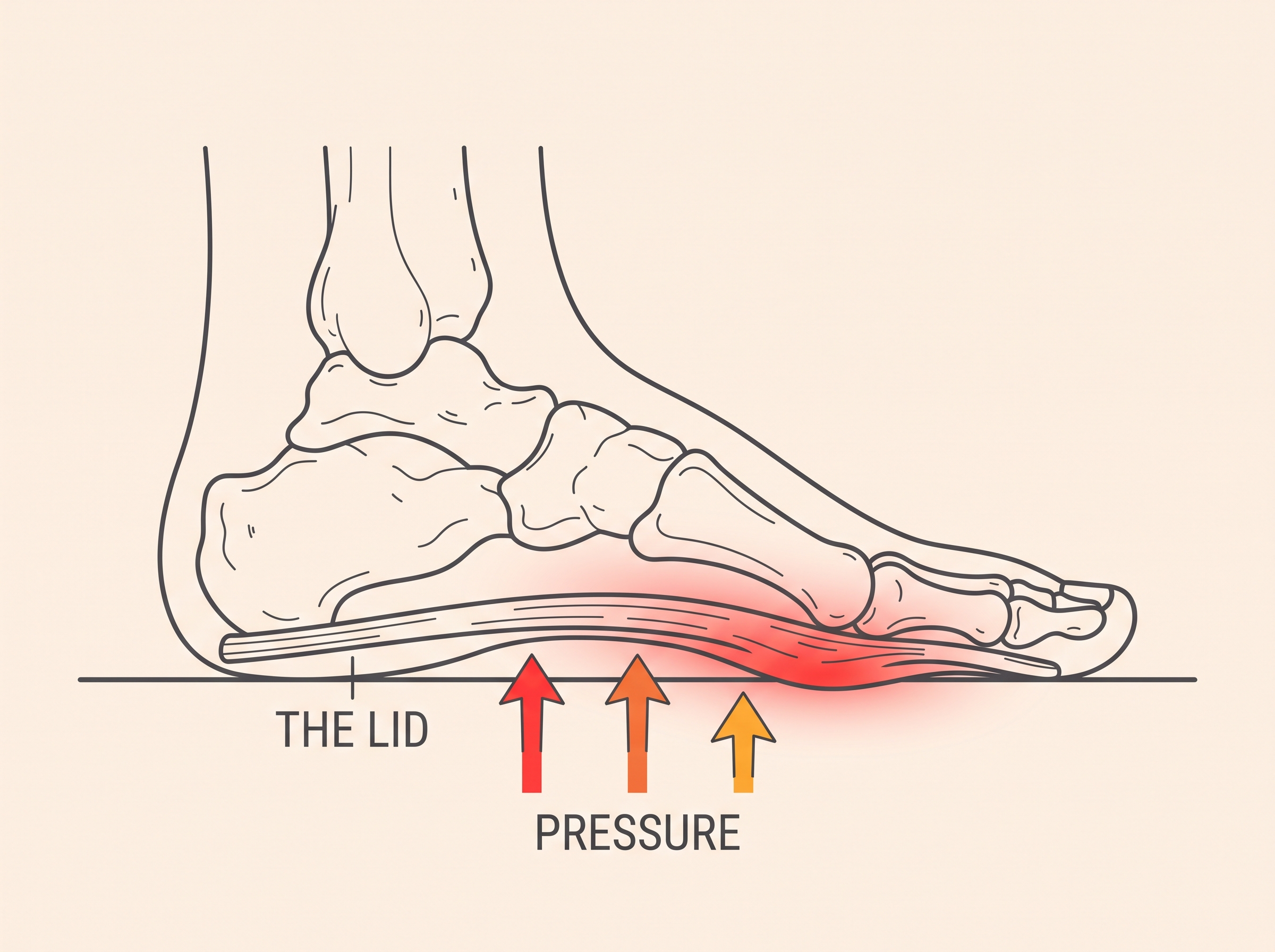
After hours of standing, there's a thick sheet of tissue running across the bottom of the foot. Think of it less like a muscle and more like a lid — it sits over everything underneath, and it's supposed to flex as you move.
Stand on it for twelve hours straight and that lid stiffens up. It clamps down. That clamping is the "packed" feeling — not swelling, not damage, just a stiff lid that's stopped moving the way it should by hour twelve.
That's the direction problem, laid out plainly: pressing on a stiff lid doesn't release it — it only drives it in harder, against the structures beneath. Every roller, every ball, every gun in that drawer was compressing the exact thing that needed to be lifted off, not pushed in.
Once that clicked, the fix stopped being a mystery. It became a direction — and a specific kind of physics I'd never once thought to ask about.
Lift, Not Press
Priya, the friend from the photo above, is the one who finally put it into words I could picture — after catching me wincing across that break room floor for the third time in a month.
If the lid clamps down under pressure, she said, the only thing that makes physical sense is the opposite of pressure. Not push. Pull.
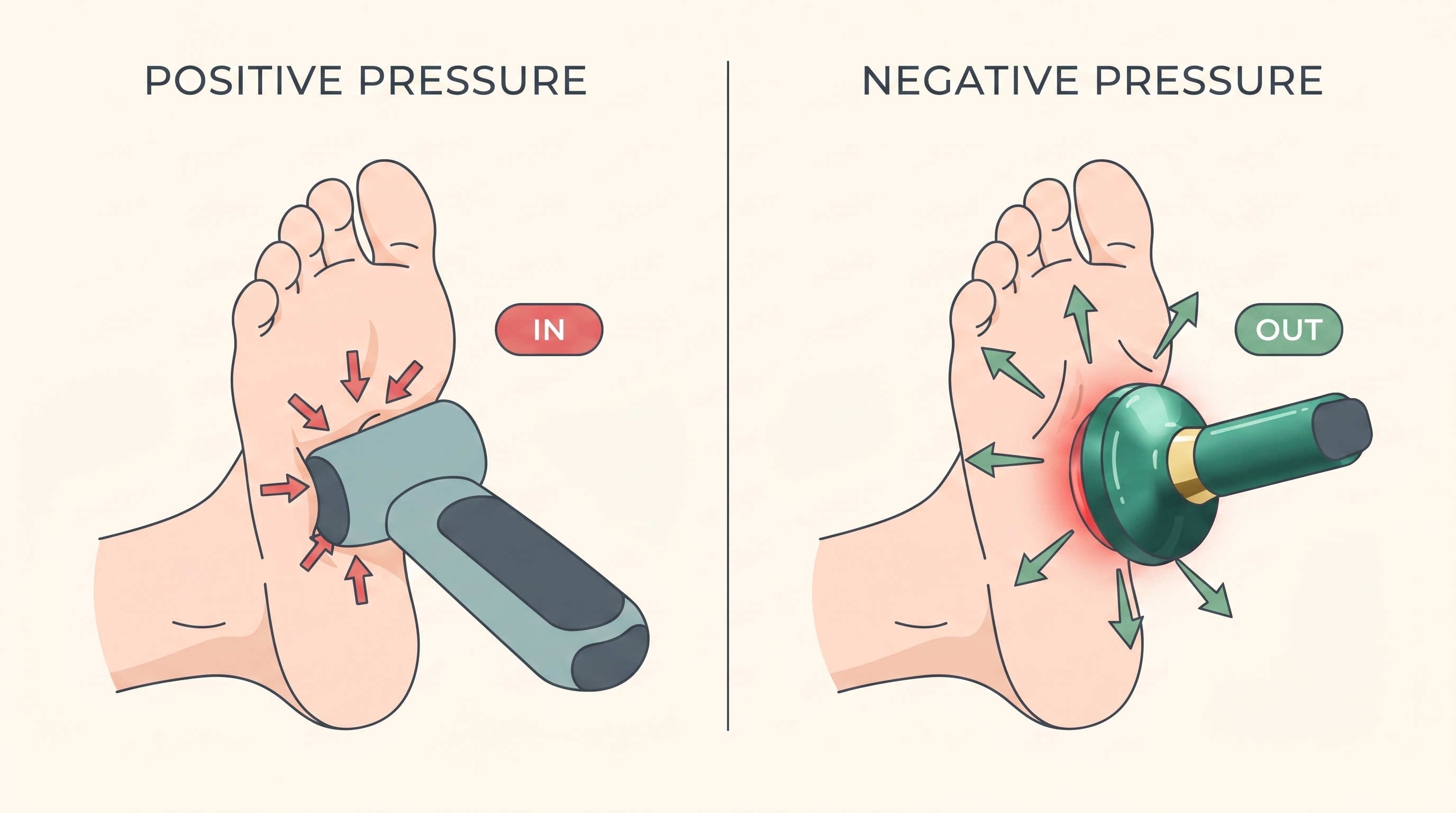
She called it "the pressure release" — and it isn't a marketing name, it's a physics term. Negative pressure. The same principle as suction: a gentle vacuum draws the tissue out and away, lifting the lid off the structures beneath, instead of driving it in. Everything in my closet worked on the exact opposite principle: positive pressure, pushing the tissue in and compressing it. Pushing in is positive pressure. Drawing it out — suction — is negative pressure. That's the entire difference, reduced to two words.
Watch that closely and the whole flip becomes obvious. Stand all day, the lid tightens, it clamps — that's the packed feeling. Positive pressure — pressing in — only drives it in harder. Negative pressure — lifting the lid off, carried by a glide — is the only direction that actually makes sense once you see it laid out that way. Ten minutes, and my feet feel lighter, looser, more like my own again.
It's a small flip on paper. Out instead of in. Suction instead of squeeze. But it's the whole reason nothing in that drawer ever fully worked.
That opposite direction — negative pressure instead of positive — is the whole reason the device Priya handed me doesn't look or work like anything else in my closet.
Positive Pressure vs. Negative Pressure — Same Foot, Opposite Direction
| Everything Else — Positive Pressure (Press Down) | The Pressure Release — Negative Pressure (Lift Up) |
|---|---|
| Rollers, balls, guns — push in and compress | Gentle suction draws the tissue out and away, lifting the lid off |
| Can clamp the lid down further if pressed too hard | Designed to release, not compress |
| Relief fades within minutes | Oil-glide carries the lift across the whole sole |
| Built on the same physics as squeezing | Built on the opposite physics entirely |
That opposite physics is also the entire reason the device itself looks nothing like anything already sitting in my closet.
What My Physio Friend Actually Handed Me
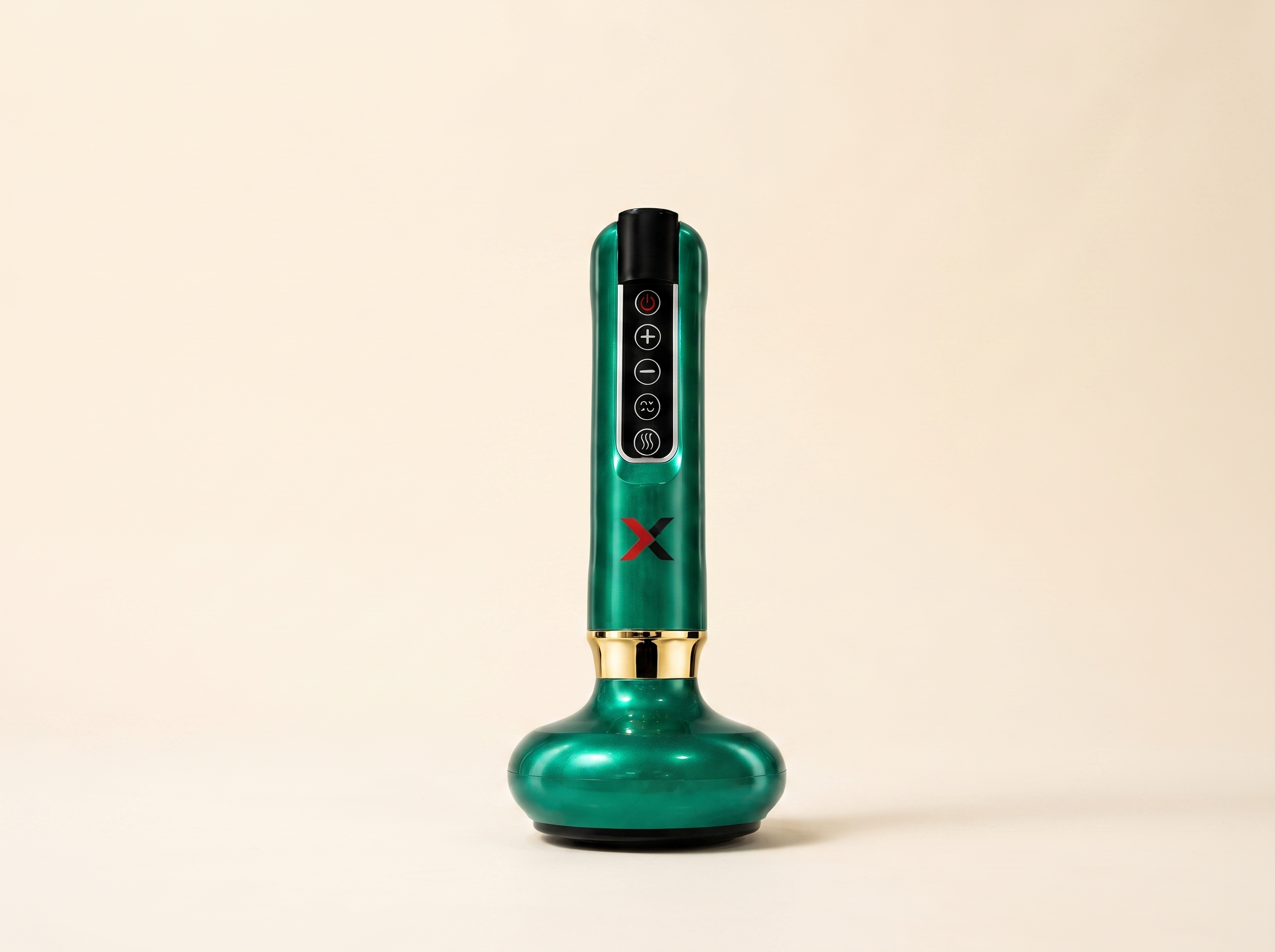
The thing Priya eventually let me borrow is called FlowLift™.
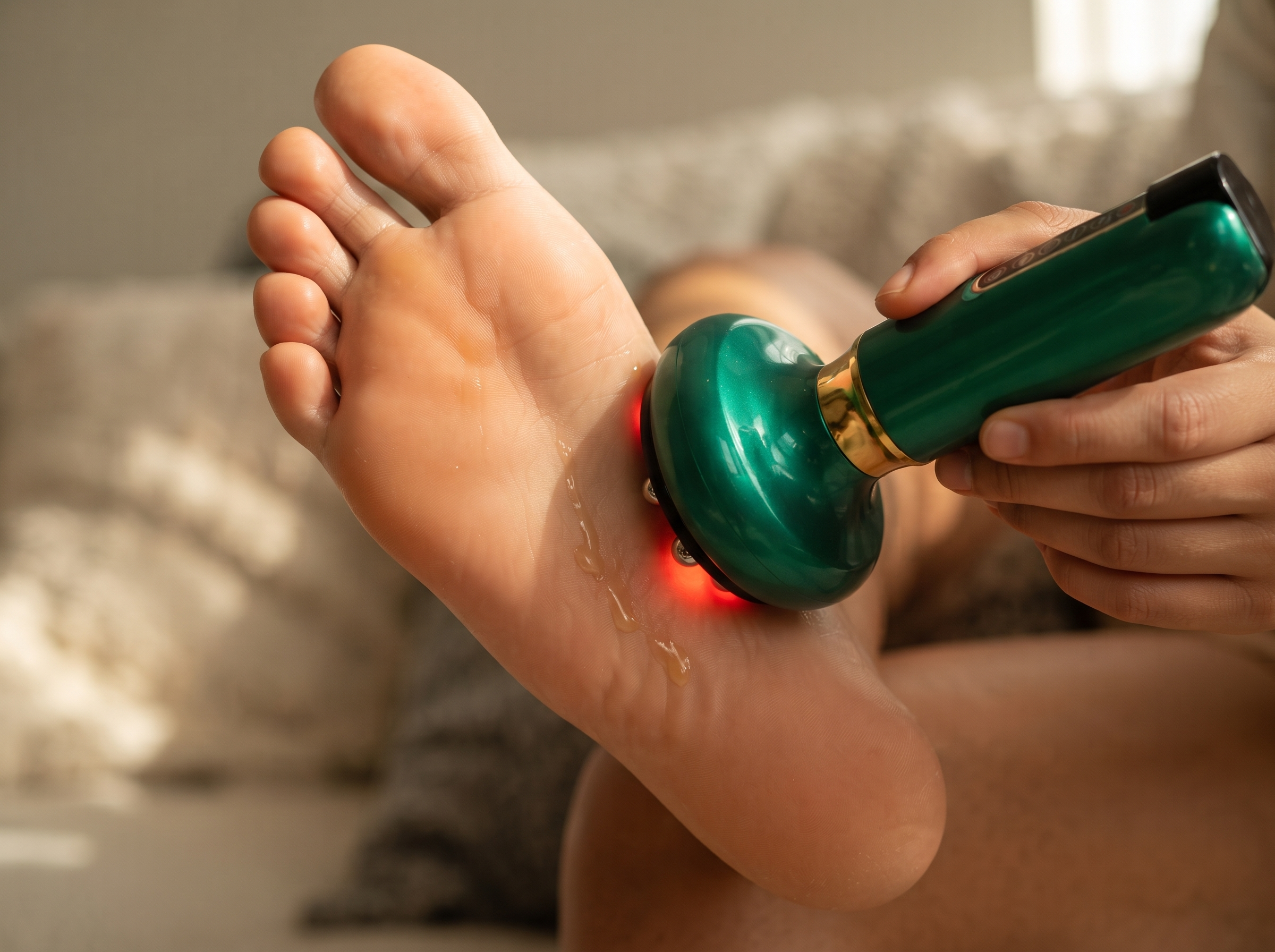
It's a small, cordless, one-handed cupping device — green, rechargeable, nothing clinical-looking about it. It does three things at once: the gentle negative-pressure lift Priya described, therapeutic warmth up to 107°F, and a low-level red light layered underneath the suction head. Twelve settings, so you can start as low as you want.
I'll be honest — my first reaction was here we go again. I'd been handed things before. But "lift, not press" is the one detail none of my other tools ever had, because none of them were built to move in that direction at all.
You use it with a light massage oil, which is what lets the suction actually glide instead of sitting in one spot and pulling at the skin.
The device only matters if the routine around it actually points in that same direction, so here's exactly what Priya walked me through.
The Ten-Minute Reset
One. Clean feet, dry feet. Thirty seconds.
Two. A few drops of the massage oil across the sole, so the suction has something to glide on instead of catching.
Three. Device on the lowest setting to start. You don't need to prove anything to yourself on night one.
Four. Glide it from the sole, up through the heel, out to the ankle. Slow. Ten minutes, done, shoes stay off for the rest of the night.
(If any of this sounds familiar — the drawer, the direction, the quiet worry that nothing's actually working — you already know why I sat down to write this out.)
The routine is what I can vouch for personally. The direction it's built on — negative pressure, not positive — is what a lot of other nurses and people on their feet all day vouch for too.
What the Numbers (and the Reviews) Say
I'm not going to pretend my one experience is proof of anything on its own, so here's what a much bigger group of people using FlowLift reported.
of first session
with regular use
recovery

 Sophie T.✓ Verified Buyer
"I work 12-hour shifts on concrete floors, and the bottom of my feet used to be wrecked by the end of it. Running this over my arches after work, and that deep ache that kept me up at night is finally gone."

 Lena V.✓ Verified Buyer
"I was on my feet building custom closets all day, and the balls of my feet and heels ached nonstop by dinner. I rolled this over the sole for a few nights, and that constant ache just isn't there anymore."

 Amber W.✓ Verified Buyer
"Warehouse job, standing on hard concrete all day, and the bottom of my feet were always screaming by lunch. Rolling this under my arch on breaks — not just quiet for an hour then back."
That's self-reported, and individual results vary — but it's consistent with what I felt, and with what a lot of people describe in their own words.
None of that erases the very reasonable question I almost didn't ask myself.
The Question I Almost Didn't Ask
I almost didn't try this at all, because the last thing I wanted was another gadget that made things worse before it made them better. That fear — of pressing on an already-packed foot and somehow making it angrier — is the exact reason I'd stopped experimenting with anything new.
The gentleness is the actual answer to that fear, not a workaround for it. Twelve settings means you can start at the lowest one and stay there for as long as you want. Nothing about the design requires you to push through discomfort. If anything feels like too much, you back the setting down or you stop.
One honest note, because I'd want someone to tell me this too: FlowLift is a wellness routine, not a medical device, and it's not a substitute for care from your doctor. If you're managing diabetes, diabetic nerve changes, or you have any open sores or wounds on your feet, check with your doctor before adding suction, warmth, or light therapy to your routine. And if swelling ever shows up suddenly, on one side only, or just doesn't go away — see a doctor. That's not something any ten-minute routine should be standing in for.
Once that question was answered, the only thing left was whether the kit made sense on paper.
The After-Shift Reset Kit — Today's Price
Here's what you actually get, before we talk about the number.
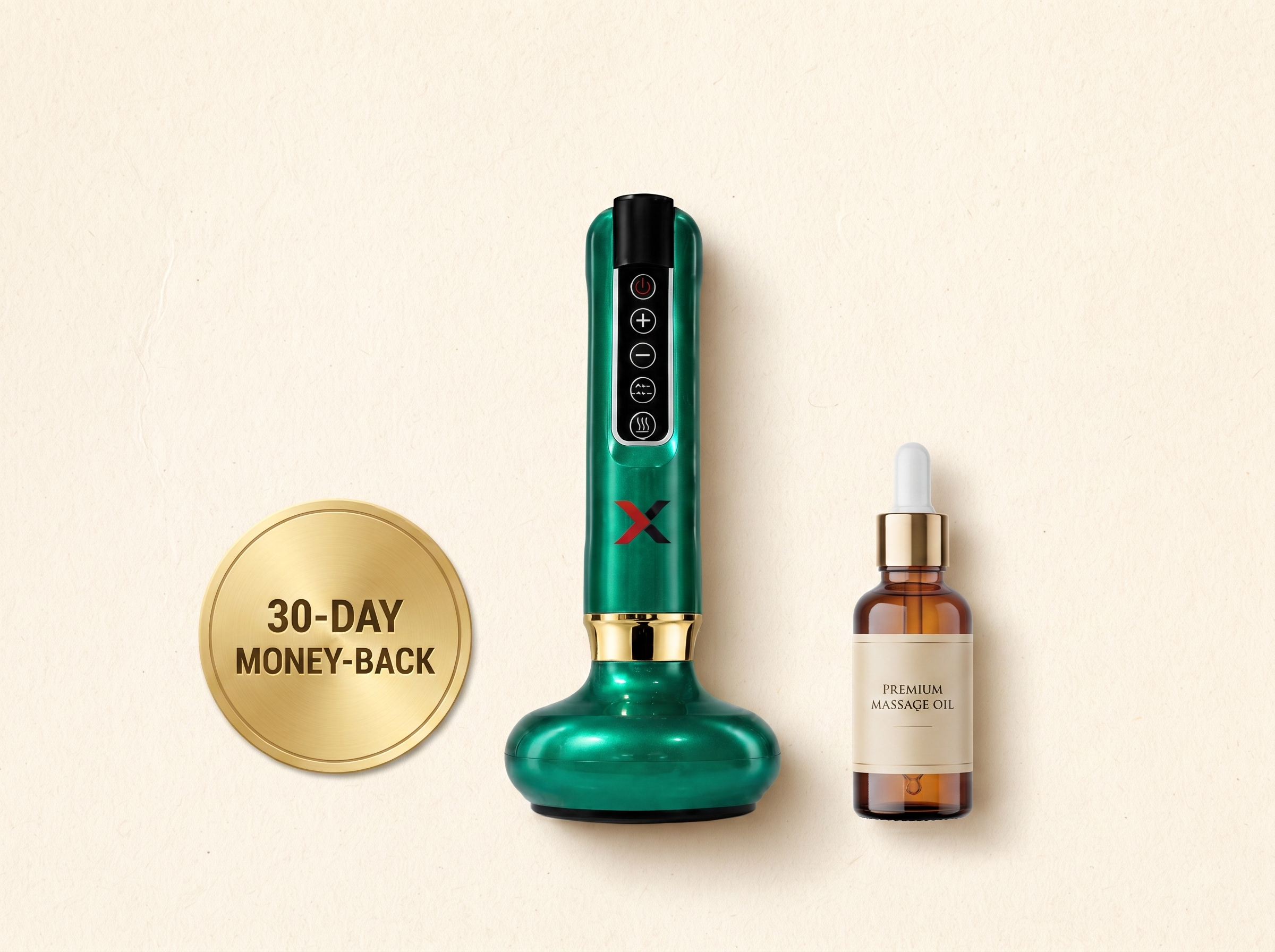
The FlowLift™ device itself — the lift, the warmth, the red light, twelve settings, cordless. The massage oil, because without it the glide doesn't work the way it's supposed to. And the same ten-minute, direction-correct routine Priya walked me through, so you're not guessing on night one.
Single Pack — one FlowLift™, plus a free 100ml bottle of massage oil (a $19.99 value on its own) — $59.99, down from $99.99.
Duo Pack — two FlowLift™ devices, plus a free 240ml bottle of massage oil — $99.99, down from $199.98. A lot of nurses order the second one for a coworker, or a partner who's on their feet just as long.
Every order is backed by a 30-day money-back guarantee — if it doesn't help, you get your money back, no complicated process. FlowLift is also HSA/FSA eligible.
None of that changes what actually happens at 7pm — which is where this started, and where it still ends, just pointed in a different direction now.
Back to 7pm
I still get home at 7pm. I still unlace my shoes the same way I have for eleven years.
The difference is the direction the ten minutes after that actually point in. That hour isn't the worst part of my day anymore. It's the part where I finally stop thinking about my feet at all.
I won't promise it works exactly this way for everyone — nobody's twelve-hour shift is identical, and results vary person to person. What I can tell you is that it's the first thing in that drawer that ever explained why it was supposed to work, instead of just asking me to trust it.
FlowLift™ is a wellness device intended to support relaxation and after-shift recovery comfort, not a medical treatment. It is not intended to diagnose, treat, cure, or prevent any disease. Individual results may vary. Statements regarding this product have not been evaluated by the FDA. If you are managing a serious medical condition, consult your physician before use. I am not affiliated with FlowLift. This is my own experience.