You Feel It In Your Sleep. It Comes From Your Neck.
If you wake between 2 and 4am, wired and exhausted at the same time, you already know this isn't ordinary restlessness.
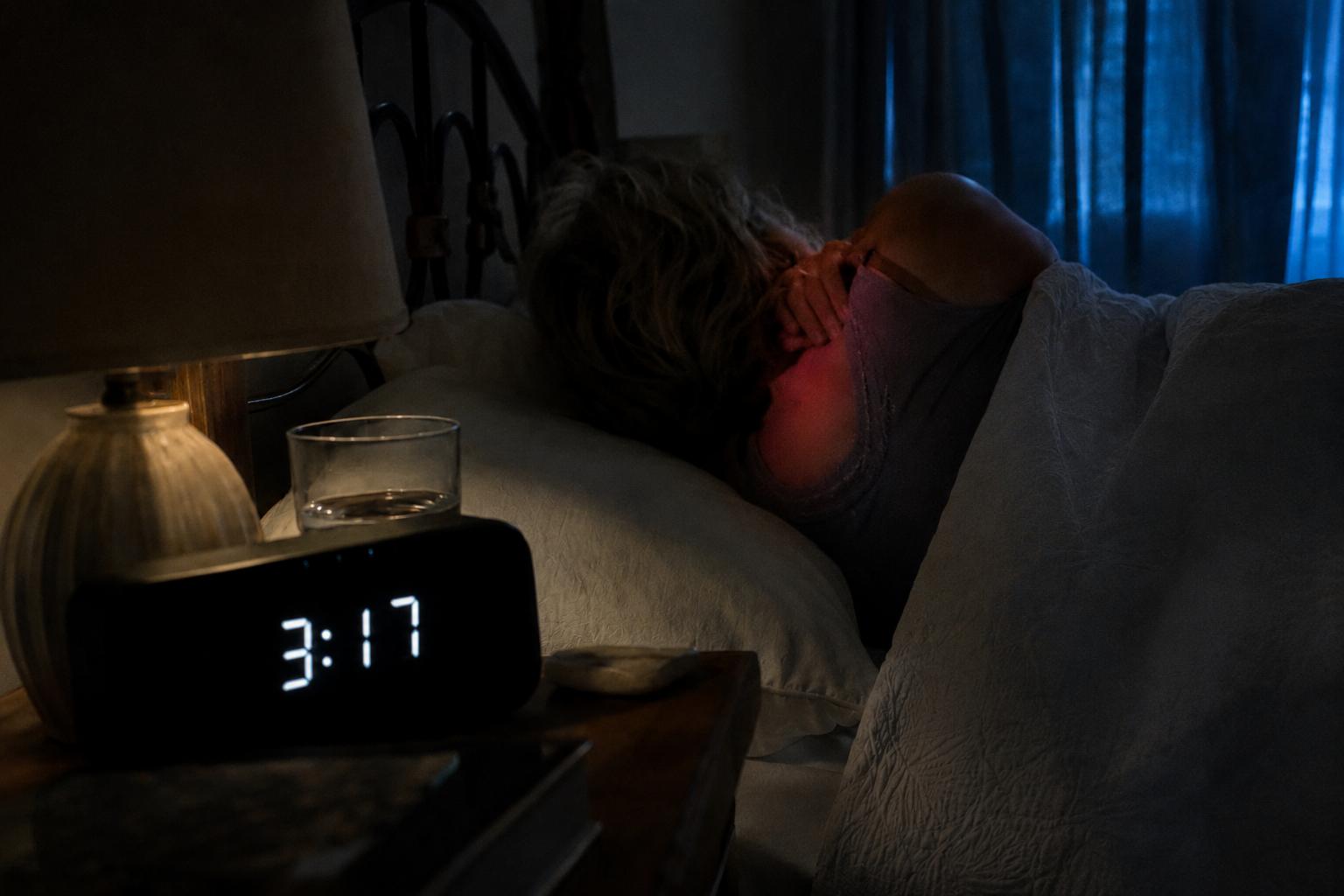
It is 3:17am.
You are awake. Completely, frustratingly awake. The room is dark and quiet and you are more alert than you will feel all afternoon.
Your neck is rigid. Your shoulders are pulled up toward your ears even though you are lying flat. There is a band of tension from the base of your skull down to the top of your shoulder blades that is, quite simply, solid.
You did not jolt awake with a nightmare. You were not startled. You simply opened your eyes and your body was already running.
That is the part that makes no sense. And that is the part nobody has explained.
A Closer Look at the Stakes
Every night this happens, you lose something harder to count than hours of sleep.
You lose the morning version of yourself. The one who is patient before the school run, clear-headed before the meeting, calm enough to be generous. She is borrowed against the night before, and the debt compounds.
You lose the confidence that you can manage the thing you are already managing. Menopause is not nothing. You are doing it without a manual. And a body that will not sleep through is one more thing you did not ask for.
The worst part is the feeling that this is permanent. That the woman who slept easily, deeply, through the whole night, is simply gone.
She is not gone. But the explanation you have been given is wrong.
Strong For Decades. Then Something Changed.
Sarah T. is 52. She spent twenty-three years in pharmaceutical sales, where sharp mornings were not optional. She managed her children's school calendars, her mother's health appointments, and three product launches in five years on four hours of sleep when she had to.
She is not someone who falls apart.
Two years ago, around the time her periods became irregular, she started waking at 3am. Fully alert. Neck locked, jaw tight, shoulders near her ears. She lay there for forty-five minutes, sometimes two hours, before her body relented.
She tried everything she could reach.
The Most Overlooked Cause of Menopause Sleep Disruption
What Sarah Tried First — and Why None of It Reached the Source
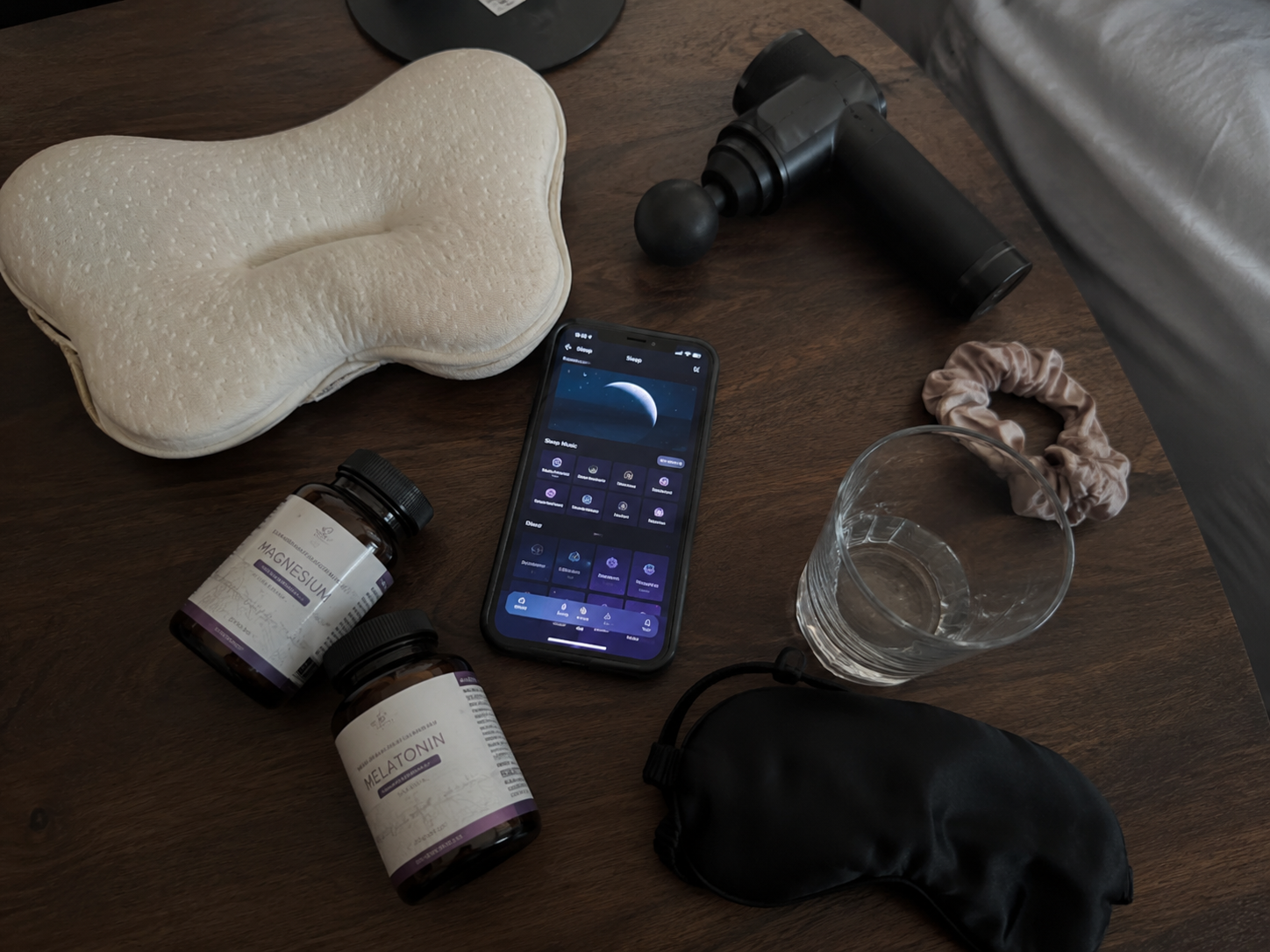
Magnesium glycinate, 400mg nightly. Her GP recommended it. She ordered the highest-rated version. It helped her fall asleep faster. It did nothing for the 3am wake-up. She still opened her eyes at the same time, body still rigid, mind still running.
Melatonin. She tried three different doses across three months. Melatonin is a sleep-onset signal. It tells the body it is dark. It does not tell the nervous system it is safe. At 3am, her nervous system already knew it was dark. That was not the problem.
Sleep apps and guided meditation. She subscribed to two. She learned box breathing and body scans and progressive muscle relaxation. Every technique worked on her mind. None of them worked on her body. You cannot think your way past a neck that physically will not release.
More pillows, then a specialist pillow, then a cervical support roll. She bought five different configurations over fourteen months. Each one changed the position her neck rested in. Not one of them released the muscle that was holding the lock. A new angle on a locked joint is still a locked joint.
A massage gun, then a partner's hands, then a hard lacrosse ball between her shoulder and the wall. She pressed into the knot every way she could find. Every technique pushed down. Every time she pushed down, the muscle guarded. A muscle under threat braces. It does not release. She was making the problem harder to reach with every attempt.
She spent, conservatively, $340 on supplements, pillows, and devices across twenty months. She received no meaningful change in the 3am wake-up pattern.
"I started thinking the word for what I had was just: menopause. Like that was the answer. Like I was supposed to accept it."— Sarah T., 52
She was not supposed to accept it. She had the wrong explanation.
The Body Part Your Sleep Supplements Cannot Reach
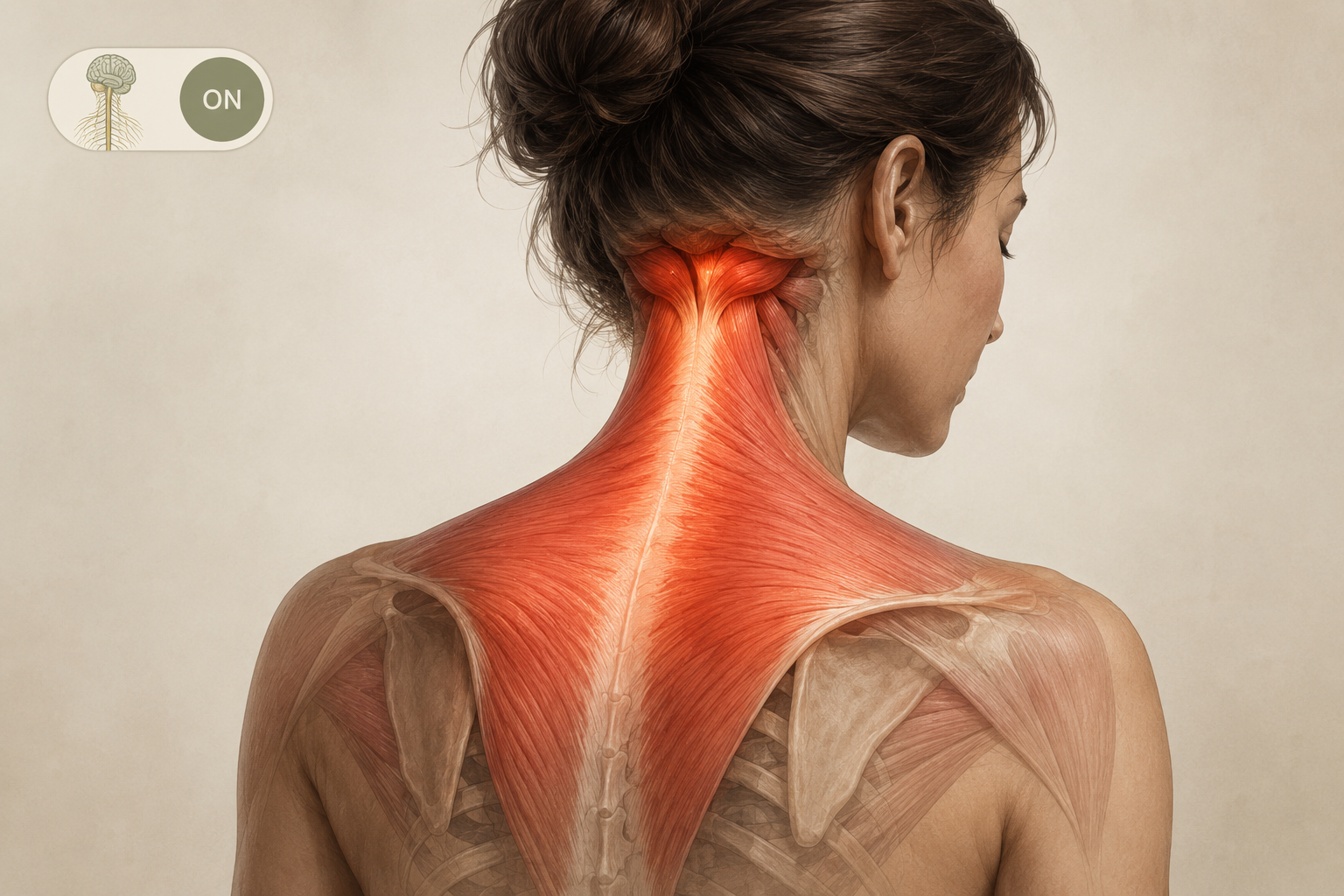
Here is what is actually happening at 3am.
During perimenopause, progesterone drops. Progesterone is not only a reproductive hormone. It functions as a natural nervous-system brake — it keeps the body's alert response from running at full volume around the clock.
When progesterone falls, that brake weakens.
A body with a weaker nervous-system brake needs to stay physically relaxed to sleep through the night. Muscles at rest, fascia soft, the signal from the body to the brain reading: no threat, nothing to defend against, safe to be here.
But many women entering perimenopause are also carrying years of accumulated tension in the trapezius, the suboccipital muscles at the base of the skull, and the upper back. That tension was always there. The progesterone was buffering its effect on sleep. When the progesterone fell, the buffer went with it.
The held tension in the neck and shoulder region keeps the nervous system in a low-grade alert state. Not a panic. Not a dramatic emergency. Just: on. Active. Running at idle with the engine never fully shutting down.
That is why the body opens the eyes at 3am. The nervous system never fully powered down. It was never allowed to.
Sleep supplements talk to the brain. They do not talk to the locked muscle at the base of your skull. Every intervention Sarah tried was aimed at the downstream symptom. Not one touched the upstream source.
How Dynamic Negative Pressure™ Targets the Root, Not the Symptom
Why Everything That Presses Down Is Working Against the Lock
A locked muscle under threat does one thing: it braces.
When a massage gun presses in, when a thumb digs at the knot, when a lacrosse ball is wedged between skin and wall, the muscle reads incoming pressure as a reason to tighten. It is not a failure of technique. It is anatomy. Pressing into a guarding muscle makes it guard harder.
Every device designed to release neck tension before Dynamic Negative Pressure™ worked on the same logic: apply force downward. None of them questioned the direction.
Dynamic Negative Pressure™ goes the opposite direction entirely.
The Vela X™ Smart Cupping Massager uses pulsing vacuum suction to lift the skin and the fascial layer up and away from the muscle. Not compress. Lift. The suction rhythmically decompresses the tissue from above, creating space rather than force. A muscle that is being lifted cannot brace against the pull. It releases.
That upward, rhythmic lift is what makes this a different category of intervention.
How Warm-Then-Lift™ Reaches the Fascial Layer First
Before the lift, heat.
Therapeutic-range warmth, delivered through the device's built-in heat element, softens the fascial layer. Fascia is a connective web surrounding every muscle. When it cools and stiffens — which it does during the low-cortisol night hours — it holds the underlying tension in place even when you are trying to rest.
Warm-Then-Lift™ is the two-step sequence: heat softens the fascia first, then the Dynamic Negative Pressure™ lifts and decompresses the layer beneath it. The heat makes the lift reach deeper. Neither step works as well alone.
The Third Element: Red Light at 660nm
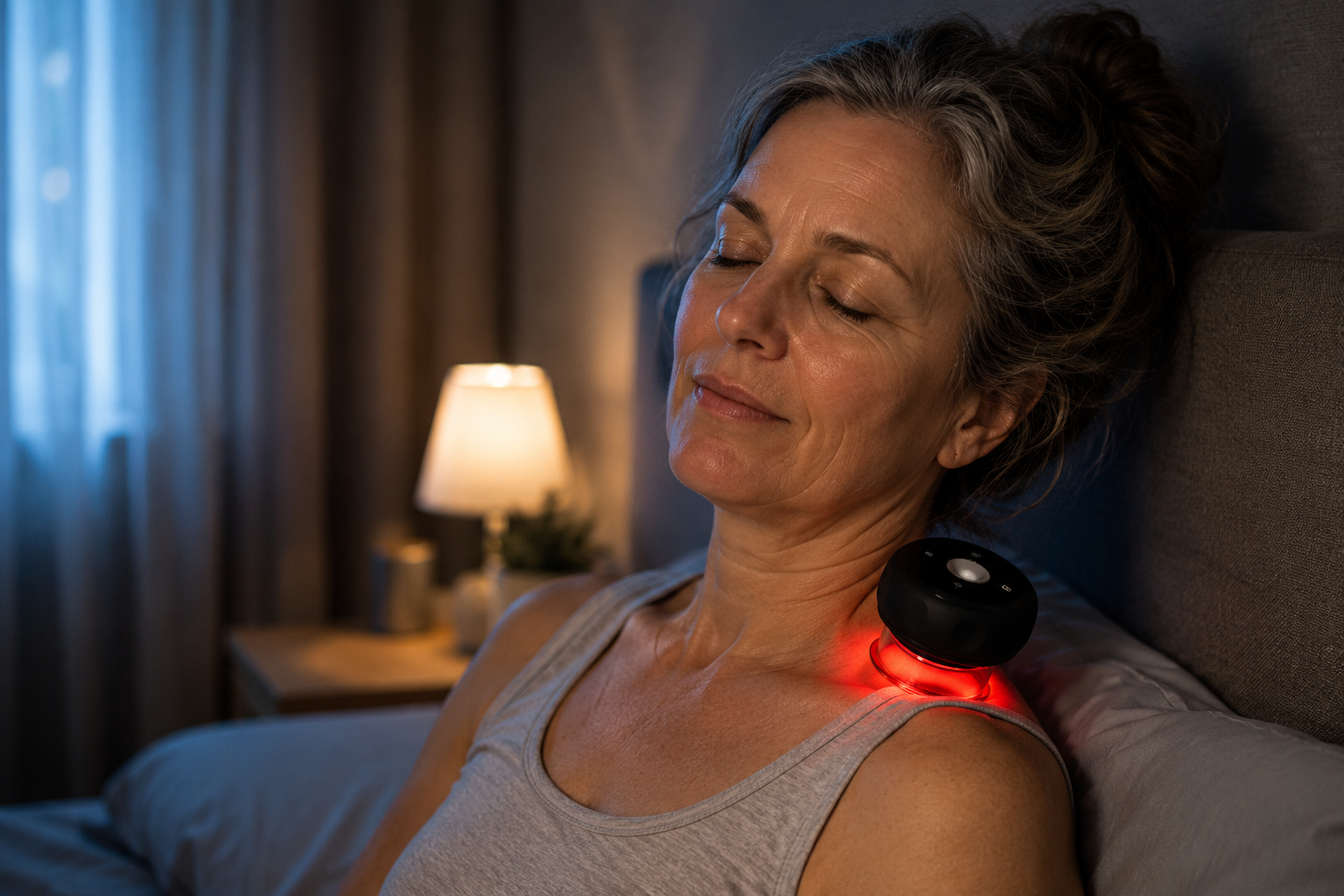
The third modality is a ring of red light (660nm) that glows through the device's transparent base against the skin.
Red light at this wavelength has been studied for its effects on cellular signaling. The Vela X™ Smart Cupping Massager's red light is included as the third signal in the sequence because tissue that has been warmed and lifted, then met with red light, helps complete the communication loop back to the nervous system.
The body's read: the threat is over. The held muscle has released. The system can stop running the alert protocol.
The Downshift Response™

When the neck releases, the nervous system has no remaining signal to keep it switched on.
This is The Downshift Response™: the transition from low-grade fight-or-flight into genuine rest. Not sedation. Not suppression. A body that has physically let go, with no remaining source of mechanical alarm, downshifts naturally. The mind follows.
The sequence is: Suction LIFTS. Heat SOFTENS. Red light SIGNALS DOWN. The Downshift Response™ follows.
A standard 10–15 minute session, placed at the upper trapezius or the base of the skull before sleep, allows the body to arrive at rest physically before the mind is asked to follow.
That is the order most sleep interventions get backwards.
What the Vela X Research Team Found
The team behind Vela X did not start in sleep products.
The original question was simpler: why does pressing into a muscle knot so often make the knot worse the next day? The answer led to research on fascial decompression and the directional mechanics of soft-tissue release. The upward lift mechanic was not invented — it was observed in existing hands-on applications and had never been packaged in a compact, accessible, at-home form.
When the research narrowed to women in perimenopause, the sleep connection became impossible to ignore. Women in this life stage were describing neck and shoulder tension they had carried for years becoming suddenly load-bearing for their sleep quality. The weakened nervous-system brake left them exposed to something they had always had. The held tension in the neck was the variable that had changed in significance, not in fact.
The mechanism design followed the physiology: if the problem is a muscle that will not release because it braces against pressure, build a device that does not press.
Dynamic Negative Pressure™ is the result of that starting question.
What Women Using the Vela X™ Smart Cupping Massager Are Reporting
"I have knots ALL the time in my back and between my shoulder blades. I started using this at the trapezius, and three nights in the 3am wake-up didn't happen. I don't know how else to explain it. It just didn't happen."
"My neck is tight, stiff and hard to turn. I've had two massages a month for four years trying to manage it. The Vela X does something in 12 minutes that the massages don't hold for four weeks. My neck actually moved freely the morning after my first session."
"Too much tension to fall asleep was my life for two years. I thought it was anxiety. I tried the Vela X at my neck, fifteen minutes before bed. I slept until 6:30 the first night. I cried."
"Waking up and not being able to fall back asleep was destroying me. My husband said I was a different person. He meant it kindly and it was still hard to hear. Six weeks of nightly use and I sleep through. I'm back."

Individual results may vary.
From Wired and Rigid to Present and Rested

| Day 1 | Day 30 | |
|---|---|---|
| Morning | Eyes open at 3am, mind running, rigid neck, lying in the dark counting the hours that remain | Alarm at 6:30, genuine surprise at how rested the body feels, neck turns without wincing |
| Getting ready | Moving slowly, every motion through the stiffness, mind already rationing the day ahead | Full range of motion, shoulders roll freely, thinking about the day rather than managing the body |
| Work & family | Present in body only, patience running on reserve, every interaction costs something | The version of yourself that other people recognize. Sharp. Genuinely there. |
| By evening | Dreading the night, already calculating strategies, lying down with tension | A short nightly session, knowing the sequence works, going to bed without negotiating with your body |
| Reclaimed | The feeling that this is just who you are now | The quiet, physical knowledge that the tension released, and sleep followed |
What You Get With the Vela X™ Smart Cupping Massager
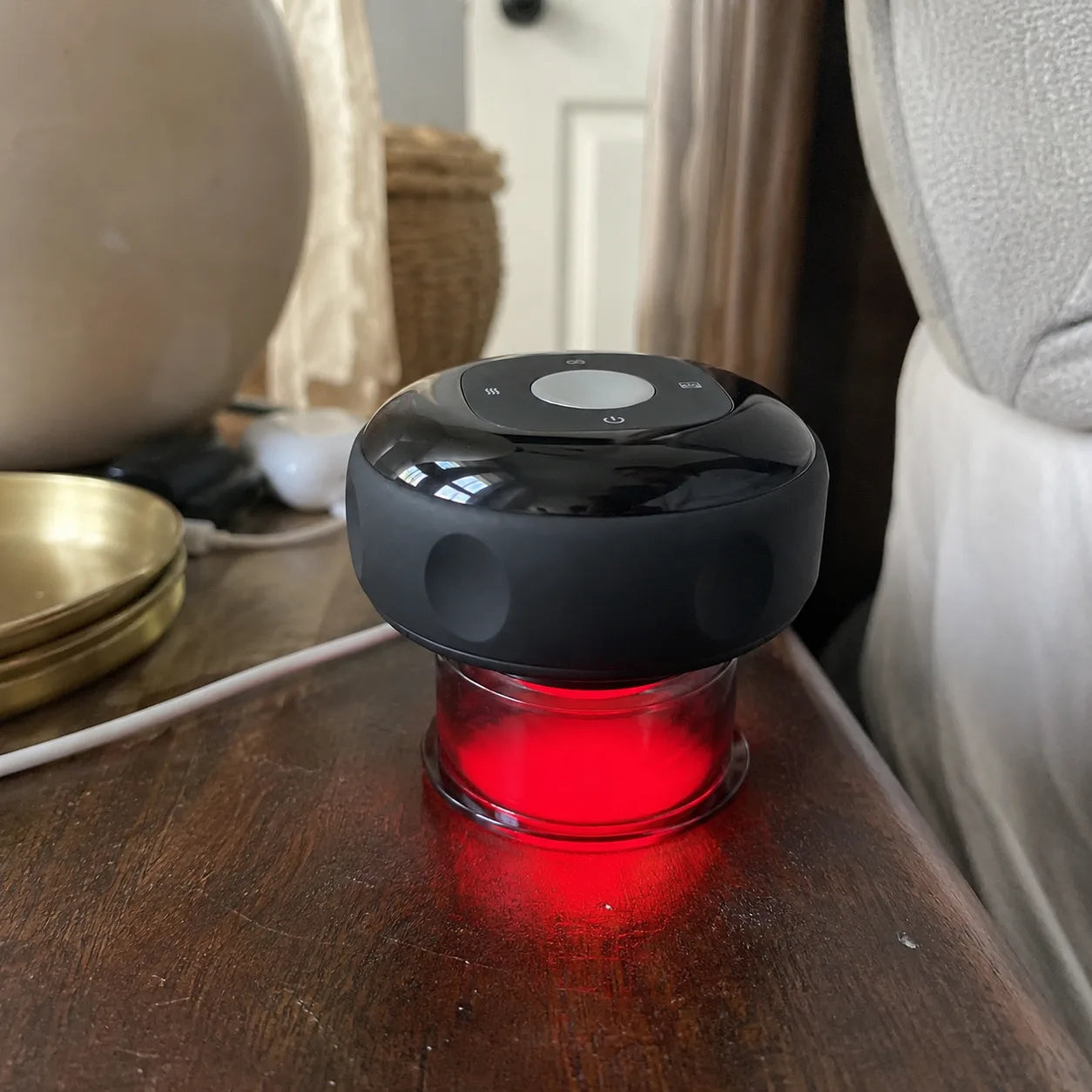
The Vela X™ Smart Cupping Massager delivers three modalities in one compact, wireless, rechargeable device:
- Dynamic Negative Pressure™ — pulsing vacuum suction that lifts and decompresses the fascial layer
- Therapeutic-range heat that softens the tissue before the lift
- 660nm red light that completes the signal-down sequence
A single 10–15 minute session, placed at the upper trapezius or suboccipital region, initiates The Downshift Response™. The device is hands-free, puck-shaped, black, with a transparent suction base, and small enough to sit in your palm. One session per night, before sleep. Vela X is HSA/FSA eligible.
Bonuses included with your order:
- Vela X Body Map — placement guide for the neck, suboccipital, and upper-back positions (which angle releases what)
- Nightly Downshift Protocol — a 7-day before-bed routine that layers the session into an existing wind-down habit
- Vela X™ Smart Cupping Massager — Dynamic Negative Pressure™ suction + therapeutic heat + 660nm red light
- Hands-free, cordless, rechargeable, palm-sized
- Bonus: Vela X Body Map (neck / suboccipital / upper-back placement guide)
- Bonus: Nightly Downshift Protocol (7-day before-bed routine)
- HSA/FSA eligible · Free shipping today
30-Day Money-Back Guarantee. Return within 30 days for a full refund — no return shipping required. The risk sits with us, not you.
Try Vela X Risk-Free for 30 Days

Use it for a full month of nights. If The Downshift Response™ does not earn a permanent place in your bedtime routine, return it within 30 days for a full refund — no forms, no return shipping. The risk sits with us, not you.
Your Three Options
Option 1: Do nothing. The 3am wake-up continues. The neck stays rigid. The morning version of yourself stays borrowed against a debt that keeps growing. That is a real choice. It is yours to make.
Option 2: Keep trying the interventions aimed at the brain. More melatonin. A new app. Another pillow configuration. You already know how that ends. The brain was never the switch that was left on.
Option 3: Try the Vela X™ Smart Cupping Massager for 30 days. 10–15 minutes at the neck before sleep. If The Downshift Response™ does not follow, return it within 30 days for a full refund. No forms. No return shipping. The only risk is one month of nights.
Try the Vela X™ Smart Cupping Massager — $59.99 ›Vela X is a wellness device intended to support physical tension release and a nervous-system downshift before sleep, not a medical treatment. It is not intended to diagnose, treat, cure, or prevent any disease, including insomnia, perimenopause, or any sleep disorder. Individual results may vary. Statements regarding this product have not been evaluated by the FDA. Consult your physician before use if you are managing a diagnosed medical condition. Do not use on broken or irritated skin, or over varicose veins. Start with a low suction setting — temporary marks may occur with cupping-style suction, as with any suction therapy.