
My Mother's Legs at 58
I taught seventh-grade science for thirty-four years. Two hundred school days a year, six hours a day, on my feet in the same pair of orthopedic clogs, because sitting down in front of thirty twelve-year-olds was basically an invitation for chaos. I was the teacher who paced. Who never sat, not even during fire drills. My legs were the one part of me I never worried about.
Somewhere around 55, they started doing something new. By 3 PM my ankles would be puffy enough that I'd feel them rubbing against my pant hem. By the time I got home and peeled off my socks, there were two deep red trenches pressed into my shins that took until almost bedtime to fade. I told myself it was the shoes. Then I told myself it was the heat, or the salt in my lunch, or just standing too much that particular week.

What I didn't want to say out loud is that I'd seen this movie before. My mother's ankles started doing the exact same thing at 58. By 65 she was wearing compression stockings to church, rolling them on every morning like a second job. By 71 she was in a wheelchair — not from a fall, not from her heart, but because her legs had simply stopped being legs she could stand on anymore. The skin on her shins had gone a dark, bruised brown that never faded. She died at 74. Even then, under the hospital blanket, her ankles were still swollen.
Every morning since it started, getting my own compression stockings on became its own quiet battle — sitting on the edge of the bed, bunching the fabric in my fists, wrestling it up over my heel while my fingers cramped, then doing the other leg, all before I'd even had coffee. Some mornings it took fifteen minutes. I was already tired before the day started, and I hadn't even left the bedroom.
Last spring I sat through my granddaughter's entire dance recital in a folding chair, because standing afterward in the lobby for pictures wasn't really an option — my shoes didn't fit right by 6 PM anymore. I told my daughter my knee was acting up. It wasn't my knee. I just didn't want to explain the real thing.
Six weeks ago, my doctor pressed her thumb into my shin, watched the dent sit there for what felt like a very long ten seconds, and said the three words I'd been quietly dreading since I was thirty years old: chronic venous insufficiency. The exact diagnosis my mother got. I sat on that exam table and felt the floor of my whole life tilt, just slightly, sideways.

The Drawer Full of Things That Didn't Work
By the time I got that diagnosis, I already had a drawer for it. Not a metaphor — an actual kitchen drawer, second one down, next to the takeout menus. Three pairs of compression stockings at $45 each, because the first two wore out from being rolled on and off every single day. A tube of muscle rub. Two different water pill prescriptions. A vibrating foot massager I bought off Amazon for $39 that my husband still teases me about.
The compression stockings helped, a little, while I had them on. The second I peeled them off at night, the swelling came right back within the hour, like it had just been waiting. The water pills — furosemide, twice — made me pee constantly and left me so worried about my potassium that I started buying bananas by the case. My doctor had to check my bloodwork every few months just to make sure the pills weren't doing more harm than the swelling was. Elevating my legs on two pillows every evening bought me maybe an hour of relief before bed. The low-salt diet changed my cooking. It didn't change my ankles.

A friend at church swore by the pneumatic compression boots her spa used, so I paid $30 to try a session. It felt like a blood-pressure cuff for your whole leg, squeezing and releasing for forty-five minutes. It was relaxing. My ankles looked exactly the same walking out as they had walking in.
I even tried the fancy option. A lymphatic drainage massage therapist forty minutes from my house, $70 a session, once a week. She was lovely. My legs genuinely felt lighter walking out of her office. By the time I got home and made dinner, the lightness was gone. I did the math one night — eight sessions, $560 — and realized I couldn't keep paying $70 a week for a feeling that evaporated by dinnertime. So I stopped.
Stockings. Two rounds of water pills. A $39 massager gathering dust. A $30 boot session. Eight massage appointments.
Almost $950 — not counting the doctor's visits.
And every single evening, my ankles still disappeared the same way they always had.
My doctor mentioned, gently, that if it kept progressing there was a procedure — vein ablation, closing off the damaged veins with heat or a laser. I looked it up. Recovery time, cost my insurance wouldn't fully cover, and no guarantee it would stop the same thing from happening somewhere else. I wasn't ready for that. I also wasn't ready to just keep doing nothing.

The Conversation That Changed Everything
My daughter Katie works in home health — she spends her days in and out of elderly patients' houses, the ones who need help after a hospital stay. One Sunday over coffee I was complaining about the massage money, and she just looked at me and said, "Mom, has anyone ever actually explained to you what's supposed to be moving that fluid back up your leg in the first place? Because it's not the massage. And it's definitely not the stockings."
I told her no. Nobody had. Four different providers — my regular doctor, a pharmacist, the massage therapist, even a vein specialist I saw once — and not one of them had ever explained why the fluid was staying down there in the first place. They'd all told me how to manage it. Nobody had told me why it was happening.

The Most Overlooked Cause of Swollen Legs Nobody Told Me About
Katie explained it to me the way she explains things to her patients' families — no jargon. She said, think about a sump pump in a basement. Water comes in through the pipe. That part happens on its own; gravity does it for free. But something else has to actively pump that water back out, or it just sits there and the basement floods. Your body works almost exactly the same way with fluid in your legs.
Your heart pumps blood down into your legs constantly, no effort required — gravity helps it along. But your heart does not pump that blood and fluid back up. Something else has to do that job, against gravity, all day long. That job belongs to your calf muscles. Every step you take squeezes the deep veins in your calf and pushes fluid back up toward your heart. Doctors actually call it the "second heart," because without it working, the real heart can't finish the job alone.

Inside those veins are tiny one-way valves — Katie called them the gates — that only let fluid travel up, never back down. When your calf muscle pumps regularly, those gates open and close the way they're supposed to, and fluid keeps moving. But with age, with years of standing still at a whiteboard or sitting at a desk, with the fascia — the tough, fibrous layer wrapped over the muscle — stiffening over time, that whole pump slows down. The gates stop getting worked. The fascia sits there like a lid, and fluid pools right where you'd expect it to: your ankles.
Katie said the reason it creeps up in your fifties and sixties isn't random, either. Fascia gets stiffer with age no matter what you do. Years of standing still at a whiteboard, or years of sitting at a desk — either one means long stretches with no walking, no rhythmic calf squeeze, and a pump that barely gets used. It's not that my legs suddenly broke. It's that the pump had probably been getting weaker and quieter for fifteen years before I ever noticed a sock mark.
Katie said one sentence I haven't stopped thinking about since. "You've been draining the water for years, Mom. Nobody ever helped you restart the pump."

Why Everything In My Drawer Was Solving the Wrong Problem
Once I understood that, every single thing in that kitchen drawer made a different kind of sense. Compression stockings squeeze from the outside — they don't do anything to wake the pump back up, which is why the swelling came right back the second I took them off. Water pills drain fluid chemically, through your kidneys, which is exactly what happened to my mother for over a decade — it treats the water, not the pump, and it comes with its own risks. Elevating my legs just borrowed against gravity for an hour. The compression boots at the spa did the same thing as the stockings, just temporarily and more expensively — squeeze from outside, nothing woken up underneath. Even the $70 massages were someone else moving the fluid for my legs, by hand, for forty-five minutes — the second I left, my own pump was still asleep.
If I didn't do something about the pump itself, I was going to keep managing the water for the rest of my life, the exact way my mother did, for the exact same number of years, with the exact same ending. I'm 61 now. She was in a wheelchair by 71. That gave me, by her math, ten years — and her decline hadn't been a straight line, it had sped up the longer nothing changed. My doctor didn't try to scare me. She just said, plainly, that the pump doesn't restart itself, and the earlier you get it moving again, the more there is to work with.

It's Called SculptFlow™
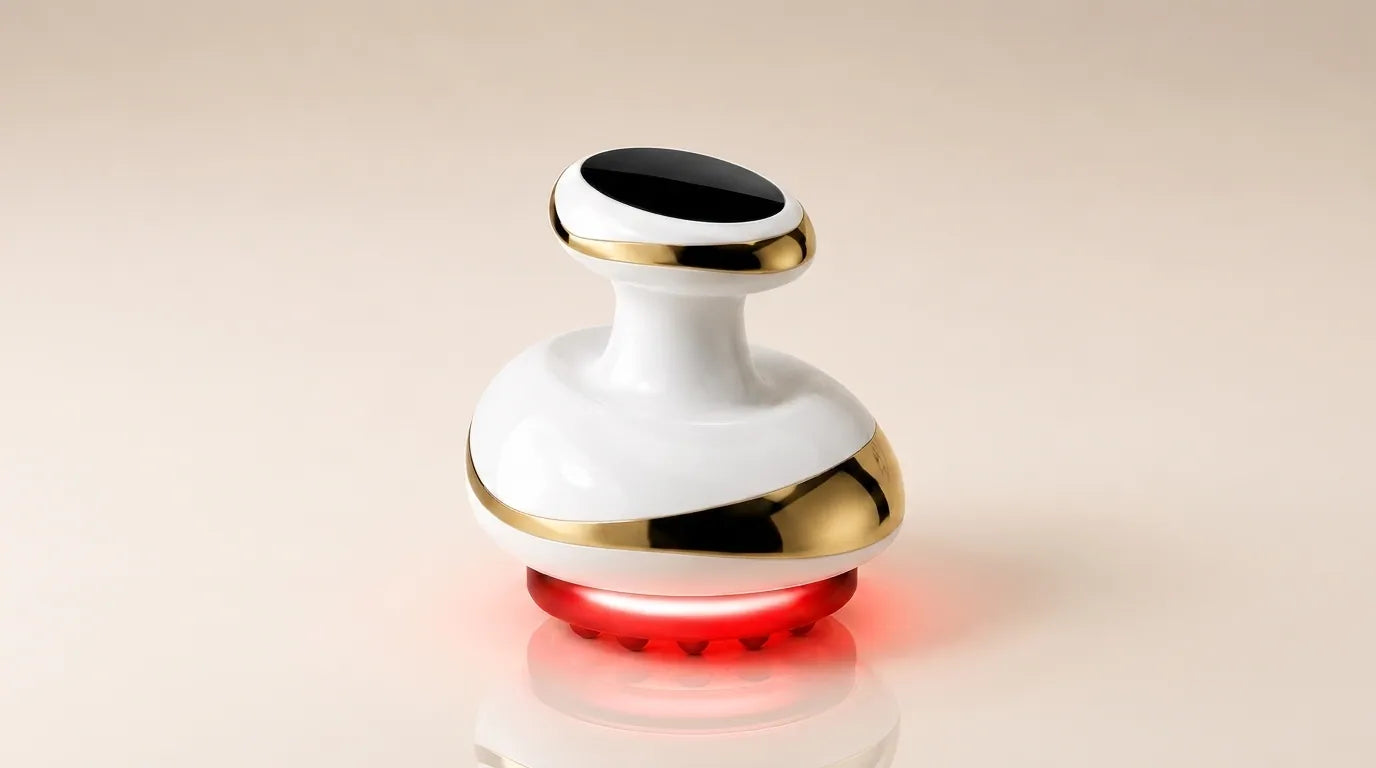
Katie found it, actually — she'd seen a version of it used at the home-health agency for patients with exactly this kind of circulation trouble. It's called SculptFlow™. It's a small handheld device you glide slowly up your calf — and instead of doing just one thing, it does three at the same time: a gentle cupping-style lift that draws the tissue upward, off the muscle; soothing warmth that helps relax and open things up; and red light on its underside to support local circulation. You sit on the couch, switch it on, and run it up each leg. A few minutes per calf.

This is the part that finally made sense to me, because it matched exactly what Katie had explained. The cupping lift is what lifts that stiff fascia layer — the "lid" — off the muscle, so there's actual room for the pump underneath to move. The warmth is what helps open things up so fluid can travel. The red light is there to support the circulation doing the work in that area while you rest. None of those three things alone had done much for me before — I'd tried a heating pad, I'd tried a cheap massager. It's the three of them together, long enough, aimed at the right place, that's supposed to help wake the whole system back up.
I want to be honest — I ordered it half-skeptical. I had a drawer full of things that had already let me down. But it was less than one lymphatic massage session, and it came with a 60-day guarantee, so the actual risk of trying it felt a lot smaller than the risk of doing nothing for another ten years.
Measure Your Ankle Before You Start
Katie told me to do one thing before I even opened the box: measure. Not guess, not eyeball it — get a soft tape measure, wrap it around the narrowest part of my ankle, write the number down, and date it. Then do the same test I'd been doing without realizing it was a test: press your thumb into your shin for a few seconds and time how long the dent takes to disappear.

That first night, my dent sat there for a full fifteen seconds before it smoothed back out. I wrote "15 sec" on that sticky note, which felt a little ridiculous, but Katie insisted. I ran SculptFlow slowly up each calf that evening, a few minutes a leg, watching my regular shows. Nothing dramatic happened that first night. But three nights in, I pressed my thumb in out of habit and caught myself staring at the clock — eight seconds. Not fifteen. Eight.
The sock marks were the next thing I noticed. Instead of two deep trenches that lasted until bedtime, they were faint lines that faded within twenty minutes of taking my socks off. Then, one Tuesday about four weeks in, I put my shoes on at 7 AM for a full day of grandkid-sitting, and that evening at 6 PM, they still fit the same. That hadn't happened in at least four years. I stood in my bathroom and just looked at my ankle bones in the mirror. I could actually see them again.

Week 1. Week 2. Week 5. Week 7.
Week one, the pitting test went from fifteen seconds to eight. Week two, it was down to seven, and the sock marks were fading within minutes instead of hours. I told myself not to trust it yet. I'd been fooled by "feeling lighter" before — remember the $70 massages.
By week five the dent was down to three seconds, sometimes barely there at all. My husband, Tom, who watched what happened to my mother right alongside me for fifteen years, noticed before I said anything. He looked at my ankles one evening while I was doing dishes and said, "I haven't seen your ankle bones since before you retired. I watched what this did to your mom. I'm not watching it happen to you too." I had to leave the kitchen for a minute.

At my seven-week follow-up, my doctor pressed her thumb into my shin the same way she had six weeks before my whole world tilted. The dent came back in about two seconds this time. She looked at the chart, looked at my leg again, and said, "Whatever you're doing, the tissue is moving better than I'd have expected at this point. Keep doing it. I don't think we need to talk about the procedure right now." I didn't tell her about the sump pump analogy. I just said thank you and drove home with the windows down.
I went back and read through the reviews before I'd even hit two seconds myself, half out of curiosity, half looking for someone to talk me out of it. 4.8 stars, averaged across 5,262 people who'd tried it. That's a lot more data points than the drawer under my kitchen counter ever gave me.

Before SculptFlow — and Now
| Before | Now |
|---|---|
| Sat through the whole recital in a folding chair, missed the lobby photos. | Stood through the entire recital and the photos after. |
| Bought socks a size up just to stop the trenches from cutting in. | Back in my regular socks — the ones I'd saved because I liked the color. |
| Told people it was my knee so I didn't have to explain the real thing. | Tell people exactly what it is — I'm not embarrassed by it anymore. |
| Planned every outing around whether there'd be somewhere to sit. | Chase my granddaughter around the backyard without thinking about my ankles first. |
| Quietly wondered if I was watching my future in my mother's wheelchair. | Wonder what I'll do with the ten years I used to assume were already decided. |

The Math Isn't Complicated
Here's the thing nobody tells you about a "cheap" fix. My compression stockings were $45 and needed replacing every few months. My water pill copays added up every month, indefinitely. Eight lymphatic massage sessions were $560, and that's before counting the ones I would have needed every single week, forever, to keep the feeling. SculptFlow is a one-time cost, it works on both legs, and Katie uses hers most nights while she catches up on her shows — it's not a once-a-week appointment you have to drive to and pay for again and again.
Choose Your Relief
60 Days, Full Refund If It Doesn't Work
I want to be upfront: I almost didn't order it because of the drawer. Because of the $950. So the thing that actually got me to click "buy" wasn't the science — it was this. SculptFlow comes with a 60-day money-back guarantee. Full sixty days to use it, do your own thumb test every week the way Katie showed me, and if your own numbers don't move, you send it back for a refund. I didn't have to trust a stranger's word for it. I just had to trust my own ankle.
GUARANTEE

Two Paths From Here
I'm not a doctor, and I'm not going to tell you which path is right for you. But I will tell you that "wait and see" was the path I was already on for six years, and it only ever moved in one direction — down, toward my mother's wheelchair.
Path 1
Keep doing what's tolerable. Reorder the stockings. Keep an eye on your potassium. Keep watching the skin on your shins for the color my mother's turned. Hope the timeline is slower for you than it was for her.
Path 2
Measure your ankle tonight. Try restarting the pump for 20 minutes a day for the next 60 days. Measure again. If the number doesn't move, it costs you nothing but the shipping label back.
I'm not going to promise you my results. I'm one woman with one pair of legs and thirty-four years of standing on them. Your ankles are not my ankles, and I'd rather you measure your own dent than take my word for it. What I can tell you is that six weeks ago my doctor said the same three words my mother heard at my age, and instead of just watching the same movie play out, I finally understood why nothing in that kitchen drawer had ever worked — and I did something about the actual pump instead of just the water. That's the whole story. Sorry it ran long.
P.S. — Katie made me promise to say this part: measure your ankle before you order anything, even if you go a completely different direction than I did. Write the number down. It's the only way you'll actually know, in four weeks, whether anything is working — instead of just hoping it is, the way I did with the massages for two months.
P.P.S. — My sister asked me to leave the link where she found it, in case anyone reading this is doing the math on the two-pack the way we did. Get SculptFlow™ here →
— Margaret H., as told to Denise Callahan